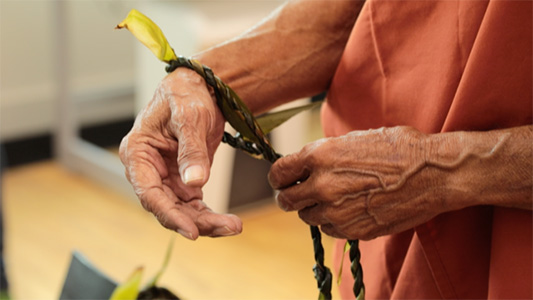
Laulima, Thousand hands, photogramme, Cérémonie au Humboldt Forum, 2024 © Natacha Nisic
WHAT ARE THE CREATIVE, WRITING, AND RESEARCH PROCESSES EMPLOYED BY ARTISTS? IS IT POSSIBLE TO CONCEIVE OF A GENEALOGY BY MAPPING THE OPERATIONAL CONCEPTS, PROCESSES, AND METHODOLOGIES EXPLORED?
OVER THE COURSE OF AN EVENING, ARTIST NATACHA NISIC SHARES THE FRUIT OF HER ONGOING WORK THROUGH A SELECTION OF ARCHIVAL DOCUMENTS, FILMS, DRAWINGS, AND PHOTOGRAPHS.
In front of the imposing glass entrance to the Humboldt Forum in Berlin, Natacha Nisic accompanies a delegation from Hawaii and a German shaman, Andrea Kalff, who have come to ask for the return of the goddess Kihawahine. Half-woman, half-snake, she lived in the ponds around the historic town of Lahaina, which was completely destroyed by fire in 2023. There are different accounts of how she came to Germany. A doctor who came to treat leprosy in 1887 is said to have seized more than 500 ritual objects on the island. By entering the museum in this way, we open the door to a multitude of stories following this plundering. The LAULIMA, Thousand Hands project consists of creating the conditions for a polyphony of voices, songs, stories, and gestures that highlight the loss of culture and identity of the Hawaiian community.
“This theater of memory, as I envision it, extends far beyond the borders of the Pacific. Like a wave, it is the spokesperson for destinies, generations, a world where living beings, human and non-human, meet, talk, and listen to each other. For it is a question of overcoming catastrophe and drama, of working from within, of pulling the strings of suffering, of laying it bare in order to better tame it. Will the goddess Kihawahine answer this call?” – Natacha Nisic
Artist and filmmaker Natacha Nisic explores the relationship between images, ritual, and memory in their historical and individual implications. Her work questions the nature of images and narratives through various media, including Super 8, 16 mm, video, photography, and drawing. She works on the representation of extreme violence, notably in the book Les fumées – Carnets d’un génocide, Rwanda 1994 – France 2018 (Creaphis, 2023). Her recent exhibitions include the Musée d’Art Moderne de Paris, the Centre Pompidou, and Bienalsur in Argentina. She directed Le Ciel d’Andrea (2013) and Plutôt Mourir que Mourir (2014) for Arte La Lucarne, on the First World War and art historian Aby Warburg. In 2021, she received the Hans und Lea Gründig Preis award for creating the Crown Letter collective, dedicated to the international visibility of women artists. She is a laureate of the Villa Kujoyama in Kyoto and the Villa Medici in Rome.
Moderator:
Pascale CASSAGNAU, art critic, head of audiovisual and new media collections at the Centre national des arts plastiques. Her research focuses on new cinematographic practices in their dialogue with contemporary creation, and on sound.