Focusing on structural change
‘Life in Industrial Landscapes – Focusing on Structural Change’ is the second part of an exhibition project that began in autumn/winter 2019/2020 with the exhibition ‘Life in Industrial Landscapes – A Photographic Inventory’. This presentation used the indexical and conceptual qualities of photography to explore the manifestations of industrial landscapes.
The starting point for the two-part exhibition project ‘Life in Industrial Landscapes’ is Carl Schütz’s iconic painting ‘Das Lendersdorfer Walzwerk’ (1838), which is part of the Leopold Hoesch Museum’s collection. The painting is a typical example of the pronounced self-confidence and self-representation of industrial families during the early industrialisation period. To this day, the landscape around Düren, between Garzweiler and the reservoirs of the Eifel, is characterised by its industrial use.
The project ‘Life in Industrial Landscapes’ is an invitation to engage with one’s own perceptions of this landscape, with the contradictory and complex spaces that open up between open-cast mines, power stations and high-voltage pylons, paper mills, sugar beet fields, the nearby Tihange nuclear power plant and the flooded areas in the surrounding countryside.
The exhibition ‘Life in Industrial Landscapes – Focus on Structural Change’ was developed in cooperation with the Brandenburg State Museum of Modern Art | Dieselkraftwerk Cottbus. As in Düren, open-cast lignite mining in Cottbus has played an important role in the city’s cultural identity and the landscape of the region for generations. The end of open-cast lignite mining is just as acute for Cottbus as it is for Düren.
The exhibition therefore focuses on artistic installations by contemporary artists who deal with lignite mining in Hambach and the increasingly noticeable consequences of climate change. Aglaia Konrad, Stephan Mörsch, Silke Schatz and Alice Creischer, winner of the 2018 Günther Peill Foundation Award, present works on opencast mining in Hambach and Inden, the tree house settlements in the Hambach Forest, Manheim and the connection between lignite mining in Düren and the international handling of resources.
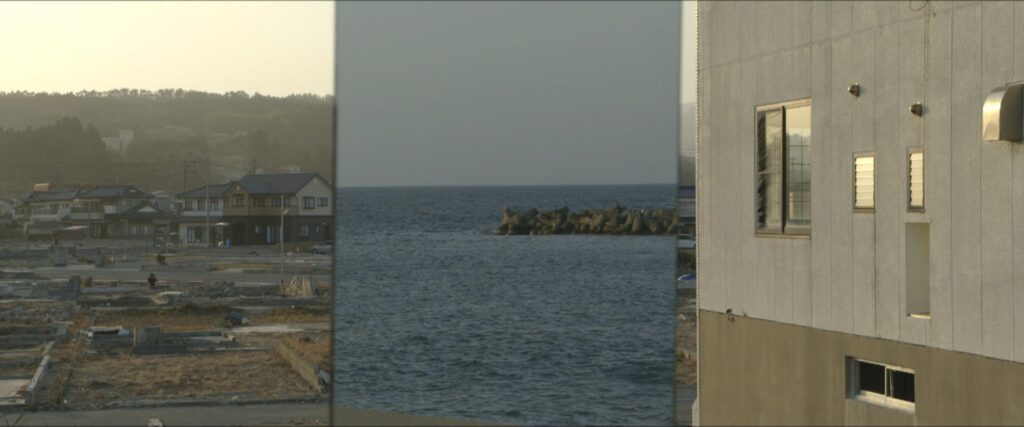
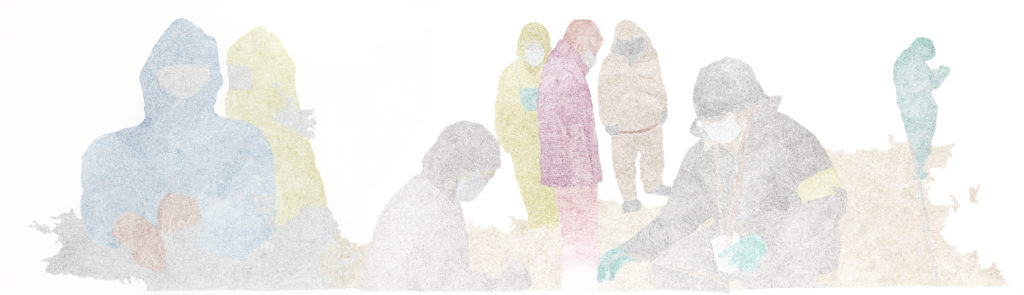
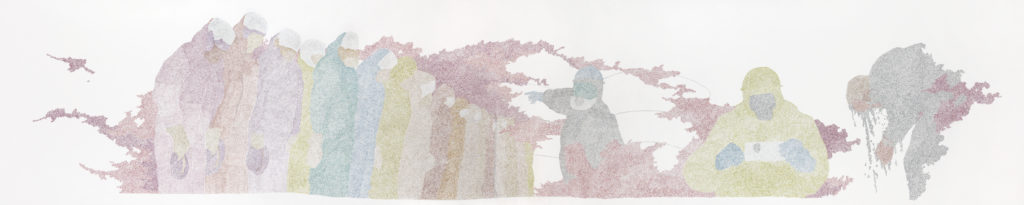
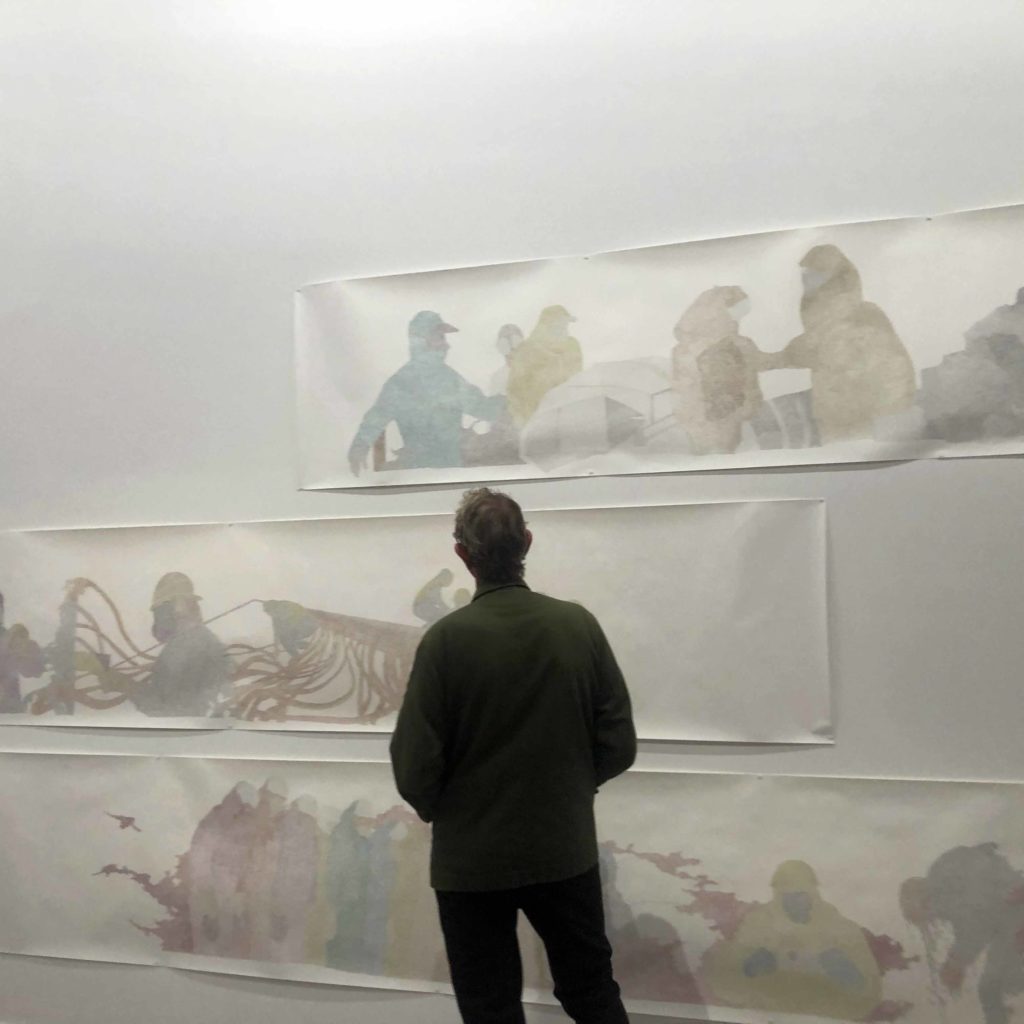
This raises the question of how the massive physical impact of open-cast mining on the landscape can be represented at all. Silke Schatz describes her work ‘Manheim Calling’ as a ‘shadow archive’ for the farming village of Manheim, which is currently being excavated. In the exhibition, her installation is juxtaposed with Natasha Nisic’s drawings and a video work that traces the traces and gaps left behind by the earthquake, tsunami and nuclear disaster in Fukushima in 2011. In her installation ‘Wald’ (Forest), Antje Majewski depicts how bark beetles are increasingly damaging coniferous forests. As in other works by Majewski, she uses painting as a means of transforming an object – the tree infested by beetles – and enabling a different form of observation. Her pictures demand an almost intimate closeness and, on the other hand, also create a sense of alienation.
Photographer Wilhelm Schürmann will present his current photo cycle ‘Urwald hinterm Haus’ (Jungle Behind the House), which was created during walks around his home town of Kohlscheid, an agricultural post-coal landscape, during the pandemic. The focus on the immediate personal environment, which will seem almost mundane to local viewers, develops in some cases a high degree of abstraction and uncertainty about what kind of image we are actually dealing with here.
Cologne-based radio authors Olaf Karnik and Volker Zander have produced an audio piece entitled ‘Vom Leben in Industrielandschaften’ (Life in Industrial Landscapes), for which they interviewed people from Düren and the surrounding area about their relationship to their landscape. Based on the reintroduction of six pairs of beavers into the Rur and Kall valleys exactly 40 years ago and the looming revival of the village of Alt-Morschenich, which had been cleared for lignite mining, a multi-voiced landscape narrative of
Rureifel and Jülicher Börde has been created in the form of an original audio essay and a room installation, between farewells and new beginnings. In the exhibition, the contemporary works are placed in relation to various historical painterly positions that characterise the two collections in Düren and Cottbus with their depictions of industrial landscapes, such as the paintings by Adolf Erbslöh and Karl Zerbe, Carl Lohse’s expressionist painting ‘Glashütte’ or the works by Dieter Dressler and Günther Friedrich from the early GDR. These are juxtaposed with other artists, such as the Cologne progressive Franz Wilhelm Seiwert, who already turned his gaze to the rural areas of the Rhenish lowlands in the years after the First World War.
The exhibited artworks reflect the different political or ideological contexts in which they were created. How, for example, do the photographs of Bernd and Hilla Becher relate to Wolfgang Mattheuer’s paintings, which were created in the late 1960s? What relationship between landscape and industrial intervention, work and life becomes apparent here? How can we explain the similarity between the still life-like images of the English artist Prunella Clough and those of Günther Friedrich, who worked in Lusatia in the early years of the GDR? To what extent are these images an expression of the political context in which they were created? Do they not rather prove that both artists are primarily concerned with exploring the possibilities of painting?
The two-part project began with the exhibition ‘Life in Industrial Landscapes – A Photographic Inventory,’ which took place at the Leopold Hoesch Museum from 27 October 2019 to 16 February 2020. The aim here was to use the indexical and conceptual qualities of photography to approach the manifestations of industrially shaped landscapes. This first exhibition featured works by Bernd and Hilla Becher, Joachim Brohm, Irmel Kamp, John Kelsey, Aglaia Konrad, Susanne Kriemann, Armin Linke, Jürgen Matschie, Angela Melitopoulos/Maurizio Lazzarato, Albert Renger-Patzsch, August Sander, Arne Schmitt, Carl Schütz and Ulrich Wüst.