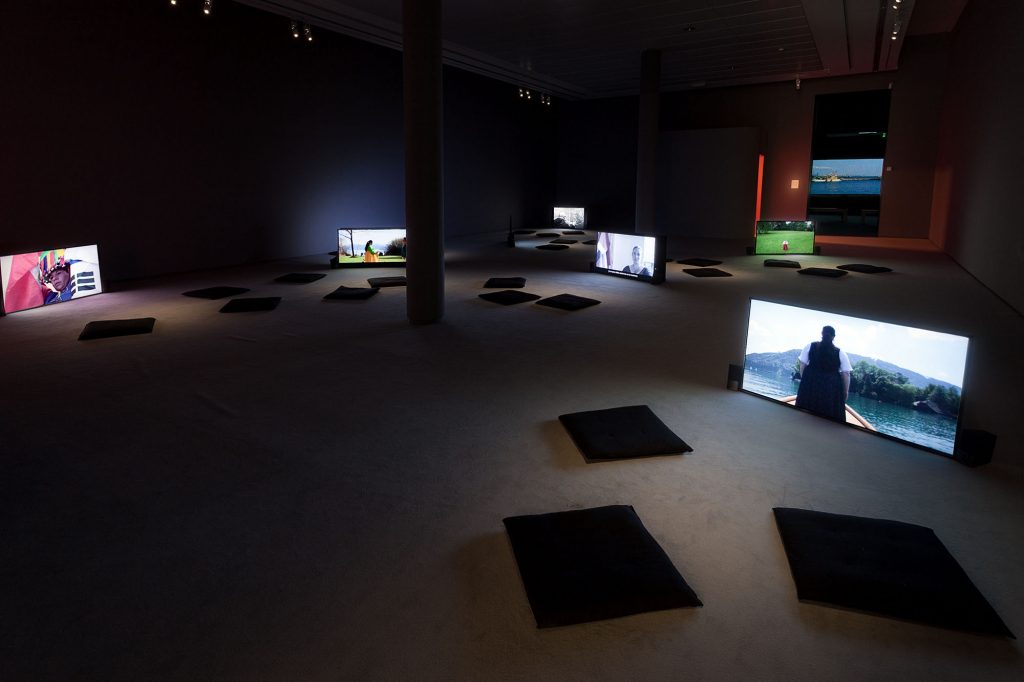
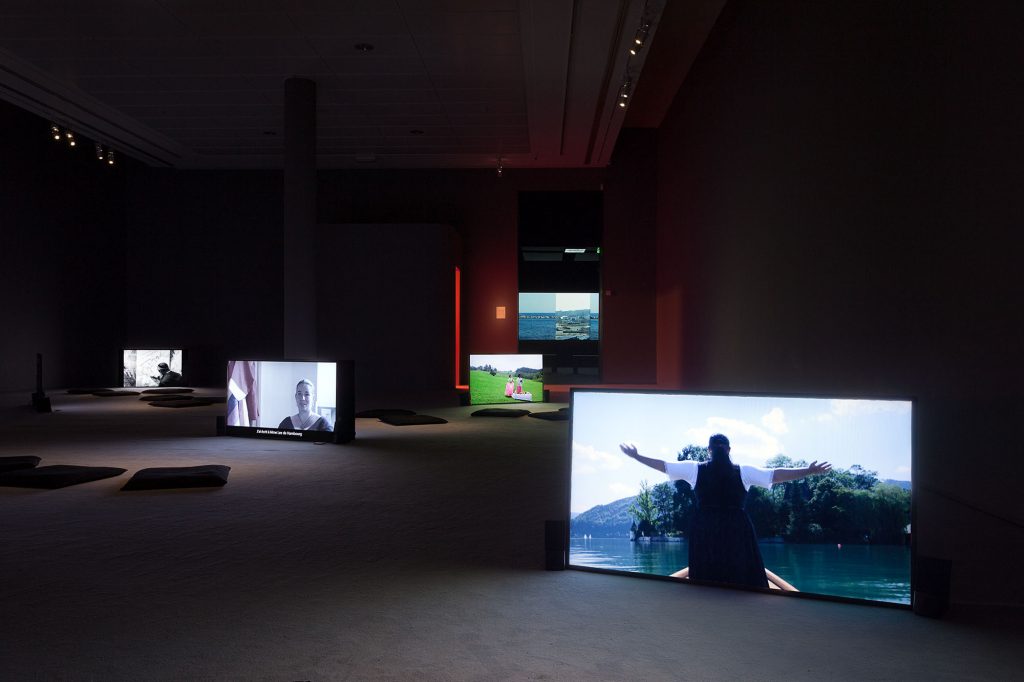
Andrea en Conversation, 9 Chanels Video, HD Stereo, Echo, Jeu de Paume, Paris 2013
ANDREA, IN THIS TRIANGULAR WORLD
Beck Jee-sook
From our country’s point of view, it is to the farthest east, and from Europe’s point of view, it is to the farthest west. A person from the farthest east wished to meet someone from the farthest west.
Park Ji-won 1
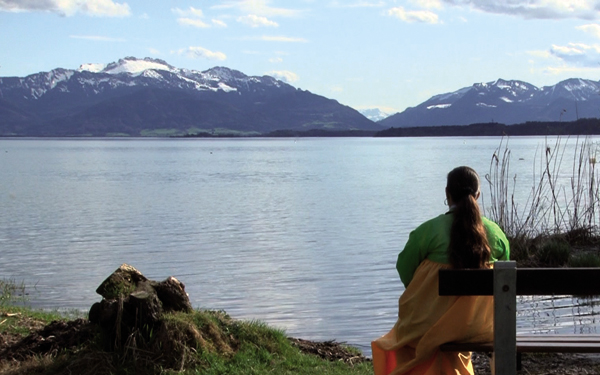
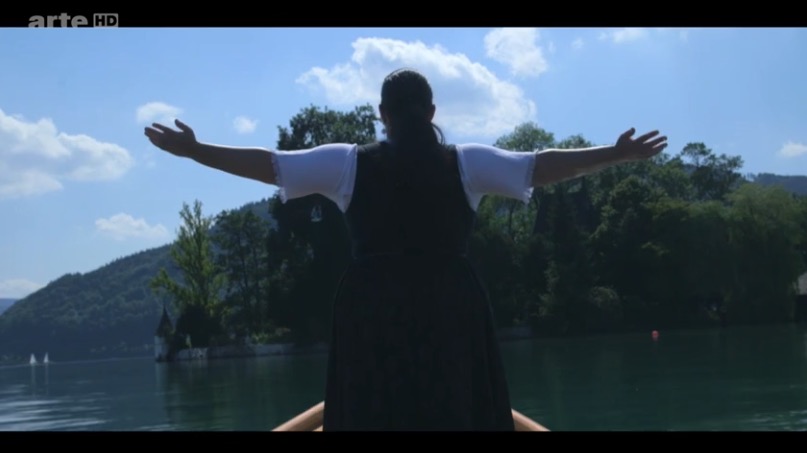
Natacha Nisic’s Andrea (2012) consists of five videos of different lengths.2 Screens playing a mix of the videos that she shot in Fischbachau in Bavaria, Germany, and footage from a Bavarian television report 3 were installed throughout the exhibition space where “K. W. Complex” 4 was held [fig. 1]. The videos, individually titled The Encounter, The Souls, Healing, Archives, and The Voices, give an oral narrative conveyed via different video languages of the strange and unfamiliar story of a person. The contrasting landscapes and colors of Germany and Korea, sounds of the wind, popular tunes, silences, and texts that sometimes interrupt and sometimes link the different scenes all provide the backdrop to, and stage for, the drama, and lend a disparate texture to the work. This heterogeneity reveals its full complexity only when we start tracking down Andrea’s “family tree.”
The “K” in “K. W. Complex,” the collaborative project between Natacha Nisic and South Korean artist Park Chan-kyong, stands for the name of the Korean shaman Kim Keum-hwa; 5 the “W” for Norbert Weber, a German Benedictine abbot who visited Korea during the Japanese colonial era at the beginning of the 20th century and who wrote a book titled Im Lande der Morgenstille, Reise-Erinnerungen an Korea (In the Land of Morning Calm). He also made a film of the same name.6 The artists divided the book 7 that followed the exhibition into K, the mother chapter, and W, the father chapter, and established Andrea Kalff, Kim Keum-hwa’s spiritual daughter, who lives near St. Ottilien, the Benedictine community that sent Norbert Weber to Korea, as K and W’s “symbolic” daughter.
The two artists met at a film festival in Japan in 2010. They discovered a common “archival impulse” inspired by an interest in Weber’s book and film, and decided to weave Park’s longstanding interview work on Kim Keum-hwa into their intellectual and visual exploration of geography and history, to which they also connected Blue Eyes Possessed by Spirits,8 which tells the story of Andrea, who flew from Germany to South Korea to be initiated as a shaman. The word “Complex” expresses the cultural complexity resulting from the geographical and historical influences in the relationship between the three characters. At the same time, it is a psychoanalytical term that suggests important feelings or thoughts that have long been repressed in many civilizations, as is also the case with family dramas. Park Chan-kyong notes that the complexity touches upon such recurring themes as imperialism, history, and inevitability, which “appear excessively” in the face of individual sickness, death, disaster, and chance in Korea. Faced with the theme, the artists, rather than opting for the easier mode of conversation, chose to focus on a certain silence, a certain opening in-between, in other words, the strong sense of rupture and contrast between the global history of an immense religious organization and the faith of an individual.9
When we expand the rhetoric of the “family” further, we discover “sisters.” When we put Natacha Nisic’s Carmel (2008) and Princess Snow-Flower (2011) alongside Andrea on the family tree, another overtone is created, above the existing vertical composition. Carmel is based on the video that the artist made in the course of a year in a Carmelite convent in Lisieux, France. The four smaller screens that fill the screen seem to accentuate the rigor and immaculacy of the lives of the 22 nuns. However, on an occasion when a novice is taking the veil, Nisic’s camera enters into this closed space, and temporarily provokes an opening in the austere screen, creating an unexpected sense of rhythm and vitality. Princess Snow-Flower is a three-channel video work that the artist produced during her residency in Gyeonggi Province on the outskirts of the South Korean capital, Seoul. It features a young shaman, clearly possessing special powers but appearing extremely tired, gossiping with her followers after performing a somewhat sloppy ceremony at a shambolic outdoor shrine. A montage of Princess Snow-Flower and Carmel would disrupt modern religious dichotomies that oppose the civilized and the primitive, religion and superstition, worship and trickery, spirituality and capriciousness, and chants and spells. Simultaneously, movements of self-contradiction and negation can be detected within Princess Snow-Flower itself. For example, the visual vocabulary of superimposed and dissolving scenes underpinning the oral narrative of the video captures the ghostlike nature of the shaman, and at the same time, renders it volatile. The appearance of the modern specter who, in order to communicate with the spiritual world, places all sorts of shamanistic tools and offerings in a secularized natural setting, and who at the same time yearns for fame, riches, and, above all, the grandness of the city of Seoul, is cut short on the screen when the shaman goes back into the woods led by “a force that she cannot disobey.” Meanwhile, Snow-Flower, whose name in Korean culture evokes images of a gisaeng 10 more than a shaman, broadens the scope of the “sisterhood” between the postulant in Carmel and Andrea. “What use would it be to become an intangible cultural asset or a national shaman? People like me . . . We don’t need men. I will initiate two women, just two, and then I’ll be done with it.” 11 If the postulant in Carmel is a daughter of the Catholic Church and Andrea a daughter of shamanism, Snow-Flower is at the same time the adopted daughter of an anonymous old lady ghost 12 and the jealous surrogate mother of a successful spiritual daughter. She is split between the sacred and the profane, making her the half-sister of the postulant and Andrea.
As such, Andrea is at the center of a complex mechanism of exclusion and oppression, or hybri-dity and syncretism, which crisscrosses the West and the East, colonialism and Orientalism, patriarchy and feminism, and different social classes and peoples. Andrea was initiated in South Korea by Kim Keum-hwa, and currently practices shamanism in Bavaria, Germany. Nisic shows Andrea to be an other in both societies. Through a process of mutual reflection and projection within her work, the two societies, each depicted from a slightly different angle through the artist’s lens, unravel the modern boundaries to which they are both tightly bound. Possessed by uncanny spirits, Andrea must certainly be an eccentric character in southern Germany, but she is just as unfamiliar and strange in traditional Korean shamanistic culture. That is because, although spirits of the other world may not have nationalities, in the real world spiritual mediums belong to a pretty solid historical and cultural terrain. During Korea’s colonization, shamans were considered to represent the other within society, because they were seen as an obstacle to the country’s enlightenment; they were subjected to a history of blatant oppression in colonial Korea, along with feng shui practitioners, begging bonzes, and instigators of riots.13 In the following era of modernization, on the one hand they were institutionalized into a taxidermized tradition through the intangible cultural assets policy pursued by the military regime, while on the other their practice became established as a religious ritual of subversion with shamanistic spirituality becoming a symbol of political resistance and cultural rebellion against authority.14 In this context, Andrea, against the backdrop of Korea’s history of colonization and modernization, embodies the Western illusion of Orientalism in its extreme form, and functions as the very rare double other, in other words, “the other from the outside world” or “the other of the other.” Her existence restores the suppressed voice of the other within our society and, at the same time, creates a crack in the nationalistic economy of local shamanism that has functioned as a counterbalance to oppression.
The five different video channels of Andrea, displayed at a distance from one another and citing, echoing, or confronting each other or just keeping their silence, are “androids” that incarnate the modern spirit. Adopting a conceptual grammar, Nisic’s video vocabulary communicates in a physical and emotional way. Already in her earlier works, the artist’s video vocabulary was reinforced by diverse hand gestures and facial expressions. In Andrea, however, it takes on an organic-mechanical nature. For the androids, headaches, stomach troubles, fractures, and tumors appear as signs of physical illnesses that attack the modernity-disciplined body; the tears and belching of the recovery process are the abjection released by the body. Unlike the working hands, the feet serve as a window that allows the viewer “to read the sadness and the deep concerns for the mother”;15 they are connected to the categories of memory and the family, which constitute the modern body. These two categories are known to form the boundary of normality that comes into play fully when modern rationality rejects the pre-modern ghost in the name of superstition.16 Andrea puts her Catholic, modern, medicine-revering parents on one side as spokespersons of modern rationality, and on the other, as a force disruptive of that rationality, places her deceased older brother and her daughter Denise, who narrowly escapes being possessed by spirits. In the process of retracing her memory, she talks of her devout Catholic upbringing and her adolescent years in a religious convent run by nuns, of how her parents threatened to cut her off from the family if she became a shaman, and confesses to being shocked when she saw the patients at the psychiatric hospital where her brother was institutionalized and locked up alongside criminals. Andrea’s effort at recollection is at its most intense when she comes into contact with her deceased brother’s spirit through a male shaman during her initiation ritual in South Korea, and it impels her to criticize her mother’s cutting of her coma-stricken brother’s hair. Like a tumor that spreads and eats up the host, the process radically and irretrievably changes her entire life by turning everything upside down: interior self and exterior world, mind and body, past and present, flesh and spirit, and the border between life and death.
In fact, in Korean culture, an individual’s body is at once an inheritance left by the parents and a “map” that allows a reading of the individual. It is believed that a personological reading—otherwise known as face or character reading—can reveal the past and future of a person, while in traditional Korean medicine, the condition of the internal organs can be diagnosed by examining the outer body. The articulated video screens of the Andrea androids extend the physical map of the body, and produce new figures within the terrain of modernity where the map of the ima-gination and the landscape of representations overlap. First, there are the interior elements in Andrea’s shrine, such as the sacrificial table and the shamanistic tools and costumes. Melons, cheese, and cake are set up next to white rice on the table. The “blue-eyed” Andrea dressed in the traditional hanbok costume grasps a five-colored flag. The white walls of her shrine even feel cozy compared to a conventional Korean shaman shrine. These same hybrid interior elements, when transposed to the lakes and mountains of Bavaria, the natural setting that inspired German Romantic landscape painting, produce a sense of incongruity. Furthermore, if Nisic’s camera explores the image of the sublime in scenes from the artist’s walk through the winter forest and views of the snowy mountain peaks, the Bavarian broadcasting company’s camera seems to expose the aesthetic territory of terror in the scenes of the strange rock on Seoul’s Inwang Mountain that Andrea visits for her initiation, and the snow-covered Ganghwa Island, where Keumhwadang 17 is located. Just like Andrea, who tries to find an analogy between the Berlin Wall and the barbed wire in Ganghwa Island, Snow-Flower, amid a surrealist landscape of English village billboards and bare mountains, and Carmel, in a familiar flower- and grass-filled landscape, are yet other forces that cut across the registers of modernity. Moreover, the intrusion of sound that continues to connect and disconnect with the visual imagery and the inclusion of the “hyper” texts that interrupt the scenes completely break down the modern worldview based on a central perspective in which everything returns to the vanishing point. In that sense, the videoscape in Andrea, which focuses more on the interrelationship between the subject and the scenery, may be closer to the samwon 18 technique used in traditional Korean painting, with its montage of different time and spatial elements combining close, medium, and distant perspectives.
In the end, Andrea’s scenario-roadmap and the resulting scenes seem to go beyond the matrix of modern dichotomies and, at the same time, investigate the capacities of contemporary culture. Andrea, by questioning whether we are able to step outside the matrix of modern dichotomies—not by abandoning them, but by regaining our capacity to act on them, and to transform what presents itself as “given” reality—even modifies the layers of meaning in Carmel and Princess Snow-Flower, and attempts to decolonize the modern colonial imagination.19
The hanbok-clad Andrea, who wanders the shores of the Bavarian lake like a phantom, reveals the diverse dialectics of an oral history. It would be difficult to claim that an autogynography, however dramatic its story, reveals a person, because of the complexity and ambiguity of its narrative mix of the imaginary, the fictive, and fact. Rather, autogynography 20 is a unique strategy of camouflage that allows the subject of the story to be anybody—whether Andrea, Snow-Flower, the postulant in Carmel, or anybody else—and is triggered by the writing impulse of a split female subject who seeks to establish her self-image as a real existence through words.21 In her lecture about her initiation, Andrea confesses to feeling cured after listening to the voices inside her and relaying the words of the spirits. In fact, her impressions coincide with the immediate healing effect of the oral narrative. Here, we have an autogynography in the form of the drama of Andrea, and an artist who listens to her narrative and interprets it with the camera, someone with a critical view in the Far East who sympathizes with her. If the affect of un-mapping modernity could rise through the flow of energy in the triangle, then who knows? We may, for a short second, be able to reach a state of mugam,22 like the family members of a follower who borrow the shaman’s costumes and dance.
1. Park Ji-won, “Written Conversations with Gokjeong,” in The Jehol Journal (1780), translated from Chinese by Lee Sang-ho, Paju: Bori Publishing, 2004, p. 365 (in Korean).
2. The exhibition “Écho” presents for the first time the work Andrea en conversation [p. 41–72], a variation of Andrea, which has four additional screens and includes new sequences.
3. These are archive images from a film report on Andrea Kalff’s initiation as a shaman in South Korea, a project that was abandoned.
4. Atelier Hermès, Seoul, October 11–December 18, 2012.
5. Listed as an “intangible cultural asset,” Kim Keum-hwa is a great shaman and the most famous of Korean shamans both at home and abroad. One of the characteristics of Korean shamanism is that it is almost exclusively made up of women (their male equivalents are very rare).
6. The book was published for the first time in 1913, while the film, which dated from 1925 (black and white, 117‘), included the very first images to be filmed in Korea.
7. K.W. Complex. Natacha Nisic, Park Chan-kyong, Paris: Fondation d’entreprise Hermès, 2013.
8. SBS Special: Blue Eyes Possessed by Spirits, 54‘ 41“, Seoul Broadcasting System, May 13, 2007. Natacha Nisic points out that the fact that such a title for this documentary film by the Korean TV was chosen despite Andrea actually having brown eyes is proof of the stereotype that Asians have about Westerners being blond and blue-eyed.
9. See K.W. Complex. Natacha Nisic, Park Chan-kyong, op. cit.
10. Gisaeng was traditionally a female artist of poetry, calligraphy, painting, and dance who entertained guests on drinking get-togethers. However, with modernization, their role declined into that of sex workers. Gisaengs have practically disappeared in Korea today. Gisaengs and shamans are both, from the gender point of view, models of the modern subaltern.
11. Excerpt from an interview with Snow-Flower from Natacha Nisic’s Princess Snow-Flower.
12. Snow-Flower keeps up a continuous dialogue with this spirit, whom she calls “Grandmother.”
13. See Park No-ja, “The People’s Discourse during the Enlightenment Era and the Others within,” in Acceptance and Transfiguration of the Concept of Knowledge during the Modern Enlightenment Era, Seoul: Somyong Publishing, 2004 (in Korean).
14. See the thesis by Chung Yong-nam, A Study on the Independent Documentary Films about Shamanism: Focusing on “Mudang” and “Between,” Osan: Graduate School of Han-shin University, Department of Visual Culture Studies, 2007 (in Korean).
15. Andrea’s word, when she is curing a woman in her shrine, from Andrea.
16. See Baek Mun-im, Girl’s Wail in Weolha, Seoul: Chaeksesang Publishing, 2008 (in Korean).
17. The shrine where Kim Keum-hwa performs gut (the Korean shamanistic ritual).
18. “Samwon, literally ‘three perspectives’ in Korean, refers to the gowon (perspective from the foot of a mountain looking up toward the mountaintop), simwon (perspective from right in front of a mountain looking beyond it), and pyeongwon (perspective from a mountain in front looking at the scenery that unfolds in the distance between it and the mountain in the background), which constitute the gaze of an artist depicting the natural landscape. Unlike the scientific Western perspective, the samwon technique, which formed the basis of traditional oriental landscape paintings, conferred a complex and dynamic movement and unique spatial beauty to the composition of the paintings.” Encyclopedia of Korean Culture, Seongam, The Academy of Korean Studies (online: http://www.encykorea.com).
19. See Anselm Franke, “Animism: Notes on an Exhibition,” e-flux Journal, summer 2012.
20. Female autobiography.
21. See Kim Seong-nae, “A Narrative Analysis of a Female Shaman’s Oral History,” Korean Women’s Study, vol. 7, 1991.
22. Mugam refers to the act of putting on shamanistic costumes and dancing to the beat of a gut (Korean shamanistic ritual) during the short breaks between shamanistic performances by a member or members of the household and / or audience where the gut is held. Since mugam is performed by ordinary people, it does not involve actual shamanistic acts related to gut, even if the people are wearing shamanistic costumes and may become agitated and excited. However, there are instances where the inherent special power of a person manifests itself, and he/she has an unusual experience. Encyclopedia of Korean Folk Culture, Seoul, The National Folk Museum of Korea, 2011 (online: http://folkency.nfm.go.kr/eng/index.jsp).
—
Translated from Korean by Meeky Song